1.11 Potentiometer Control
So far, we’ve used digital inputs - simple ON/OFF signals like button presses. Now let’s explore analog inputs - signals that can vary smoothly between minimum and maximum values, like a dimmer switch!
Analog inputs let us read real-world measurements: brightness levels, temperature, sound volume, position of a knob, and much more. The Pico W has a built-in ADC (Analog-to-Digital Converter) that transforms these smooth analog signals into digital numbers our code can understand.
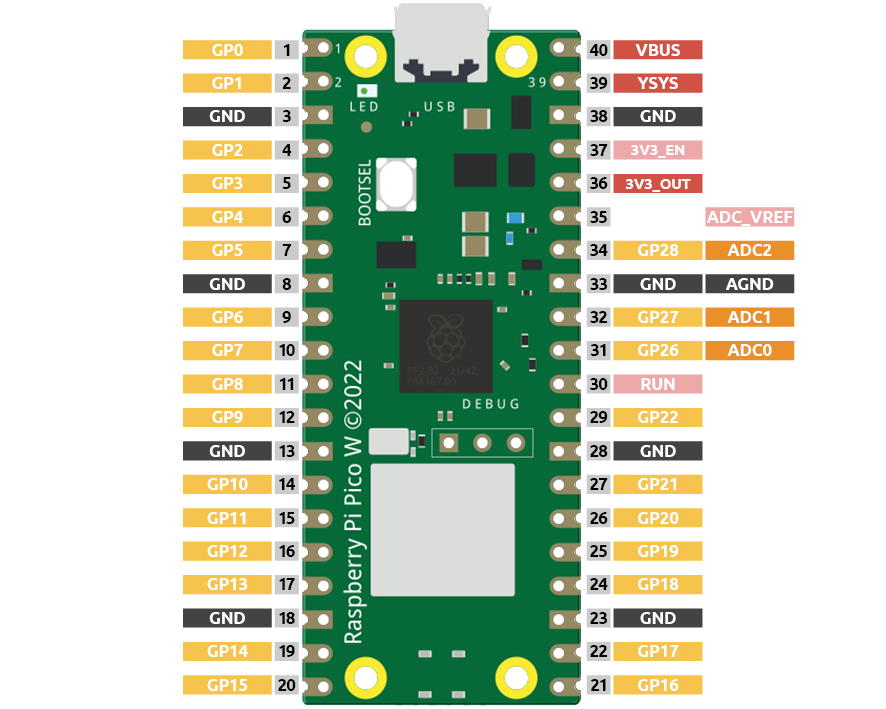
The Pico W features three GPIO pins capable of analog input: GP26, GP27, and GP28, corresponding to analog channels 0, 1, and 2. Additionally, there is a fourth analog channel connected to an internal temperature sensor, which we won’t cover here.
In this project, we will focus on reading the analog value from a potentiometer.
Component List
Raspberry Pi Pico W x1
MicroUSB cable x1
830 Tie-Points Breadboard x1
Jumper Wire Several
Resistor 220Ω x1
LED x1
Potentiometer x1
Component knowledge
Potentiometer
How our analog brightness control works: - Potentiometer: Acts like a variable voltage divider - turn the knob to change voltage from 0V to 3.3V - ADC conversion: Pico W reads this voltage and converts it to numbers (0-1023 in Arduino) - PWM output: We map these numbers to LED brightness values (0-255)
Turn knob left → Lower voltage → Dimmer LED Turn knob right → Higher voltage → Brighter LED
This creates smooth, real-time brightness control!
Connect
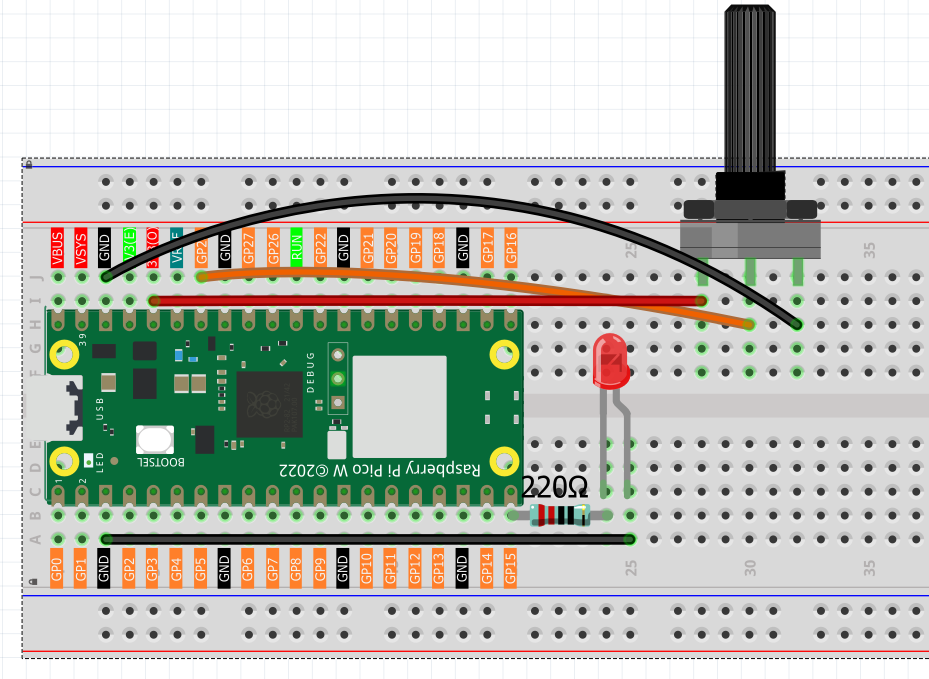
Code
Note
Open the
1.11_potentiometer_control.inofile under the path ofUltimate-Starter-Kit-for-Pico-W\Arduino\1.Projector copy this code into Thonny, then click “Run Current Script” or simply press F5 to run it.Or copy this code into Arduino IDE.
Don’t forget to select the board(Raspberry Pi Pico) and the correct port before clicking the Upload button.
After running the code, turn the potentiometer knob and watch the magic! The serial monitor shows real-time readings, PWM values, brightness percentages, and even a visual brightness bar. The LED brightness changes smoothly as you turn the knob - perfect analog control!
The following is the program code:
/*
  LED Brightness Controller

  Controls LED brightness using a potentiometer input.
  Shows real-time values and provides smooth brightness control.
*/

// Pin definitions and constants
const int POTENTIOMETER_PIN = A2;   // potentiometer connected to analog pin A2
const int LED_PIN = 15;             // LED connected to pin 15
const int READING_DELAY = 100;      // delay between readings in milliseconds
const int MIN_ANALOG_VALUE = 0;     // minimum analog reading
const int MAX_ANALOG_VALUE = 1023;  // maximum analog reading
const int MIN_PWM_VALUE = 0;        // minimum PWM output
const int MAX_PWM_VALUE = 255;      // maximum PWM output

// Variables for brightness control
int currentReading = 0;             // current potentiometer reading
int ledBrightness = 0;              // calculated LED brightness
int lastReading = -1;               // previous reading for change detection

void setup() {
  // Configure LED pin as output
  pinMode(LED_PIN, OUTPUT);

  // Initialize serial communication
  Serial.begin(115200);

  // Display control information
  showControlInfo();
}

void loop() {
  // Read potentiometer and update LED
  updateBrightnessControl();

  // Wait before next reading
  delay(READING_DELAY);
}

// Function to display control information at startup
void showControlInfo() {
  Serial.println("=== LED Brightness Controller ===");
  Serial.println("Turn potentiometer to adjust brightness");
  Serial.println("Range: 0% to 100% brightness");
  Serial.println("================================");
  Serial.println();
}

// Function to read potentiometer and control LED brightness
void updateBrightnessControl() {
  // Read current potentiometer value
  currentReading = analogRead(POTENTIOMETER_PIN);

  // Convert analog reading to PWM value for LED brightness
  ledBrightness = map(currentReading, MIN_ANALOG_VALUE, MAX_ANALOG_VALUE,
                     MIN_PWM_VALUE, MAX_PWM_VALUE);

  // Apply brightness to LED
  analogWrite(LED_PIN, ledBrightness);

  // Only display info when value changes significantly (reduce serial spam)
  if (abs(currentReading - lastReading) > 10) {
    displayCurrentStatus();
    lastReading = currentReading;
  }
}

// Function to display current brightness status
void displayCurrentStatus() {
  // Calculate percentage for user-friendly display
  int brightnessPercent = map(ledBrightness, MIN_PWM_VALUE, MAX_PWM_VALUE, 0, 100);

  Serial.print("Potentiometer: ");
  Serial.print(currentReading);
  Serial.print(" | LED Brightness: ");
  Serial.print(ledBrightness);
  Serial.print("/255 (");
  Serial.print(brightnessPercent);
  Serial.println("%)");

  // Show visual brightness indicator
  Serial.print("Brightness: [");
  int barLength = brightnessPercent / 10;  // scale to 0-10 for visual bar
  for (int i = 0; i < 10; i++) {
    if (i < barLength) {
      Serial.print("█");
    } else {
      Serial.print("░");
    }
  }
  Serial.println("]");
  Serial.println();
}