2.9 Animal Motion Detection System
In this project, we use pir and servo to make a lucky pet. The PIR Module is used to detect the visitors and servo is used to imitate the beckoning motion of the lucky cat.
Component List
Raspberry Pi Pico W x1
MicroUSB cable x1
830 Tie-Points Breadboard x1
Servo x1
PIR Motion Sensor Module x1
Jumper Wire Several
Circuit Configuration
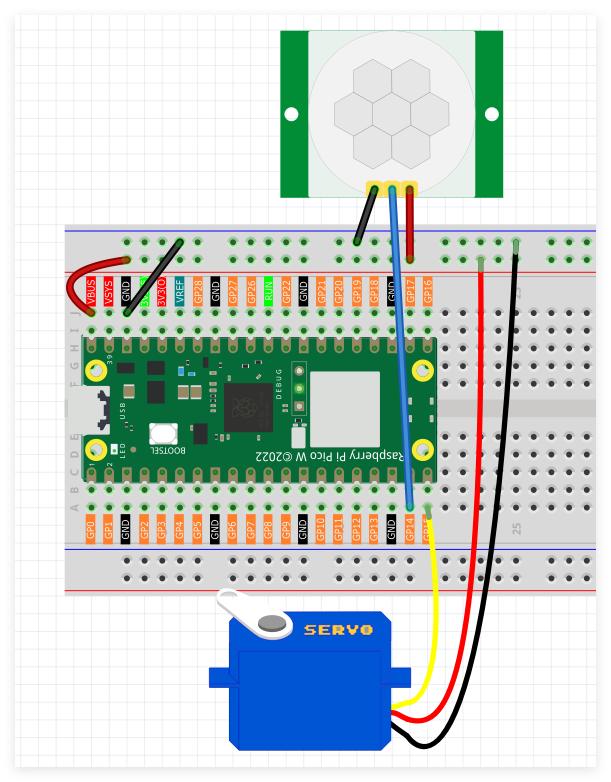
PIR motion sensor interfaces with digital input pin GP14.
Active buzzer connects to digital output pin GP13.
Programming Implementation
Note
Follow the visual programming guide below using drag-and-drop techniques.
Load
2.9_Pets_Welcome.pngfrom the directoryUltimate-Starter-Kit-for-Pico-W\Piper_Make. For comprehensive guidance, see Loading Existing Projects.
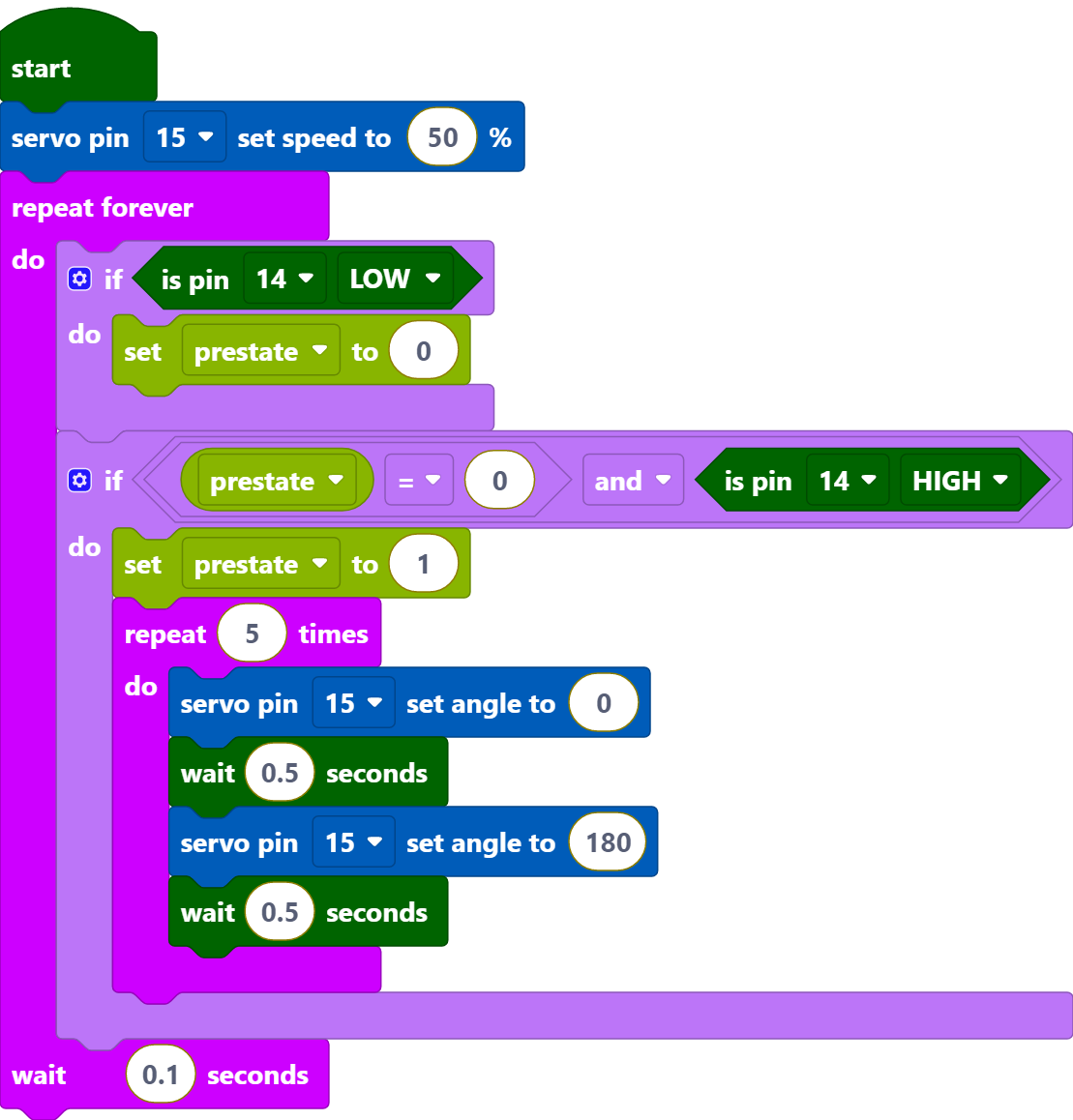
Upon Pico W connection, press the Start button to begin program execution. Move your hand within the PIR sensor’s detection range to activate the welcoming audio response.
How it Works?
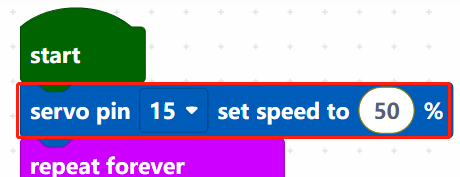
Set the rotation speed of pin15 (servo) to 15%.
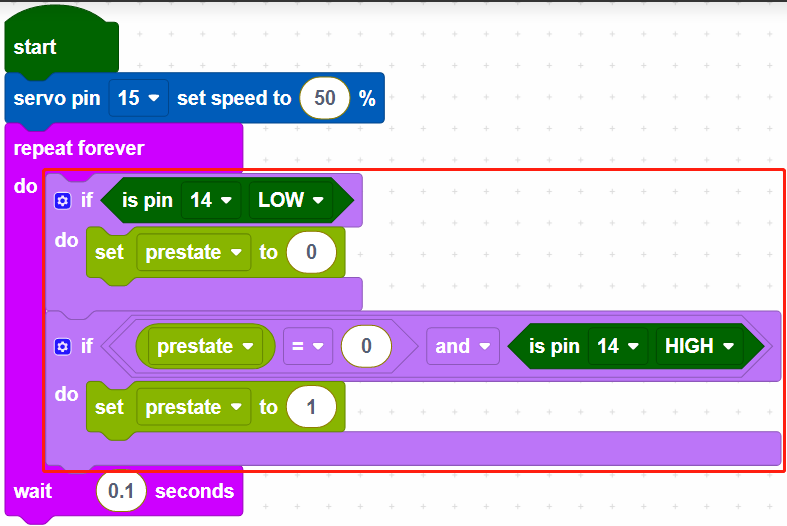
If GP14 is low, set the variable [prestate] to 0. When the variable [prestate] is 0 and GP14 is high (human detected), set the variable [prestate] to 1.
The purpose of this is to make the main code work only when the GP14 changes from low to high, and to respond only once if the PIR module keeps detecting people.
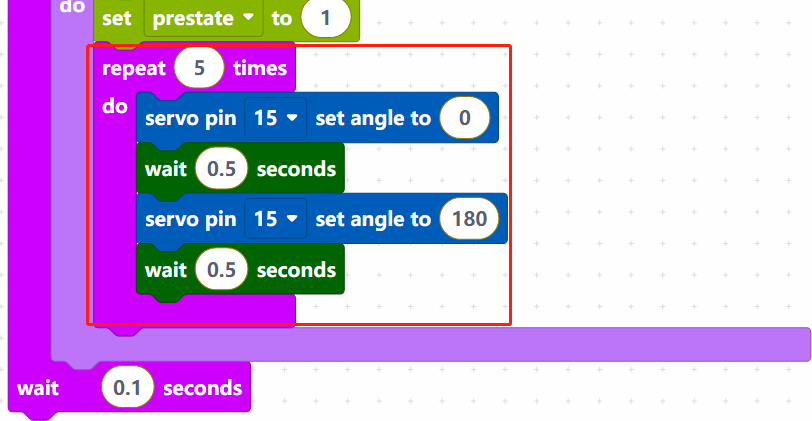
Make the servo cycle 5 times from 0 to 180 degrees rotation.
[repeat () times do]: Loop through the code inside the do block a finite number of times.