2.6 Pump Control
Let’s build something that moves water! Mini water pumps open up amazing project possibilities: automatic plant watering, desktop fountains, aquarium circulation, or even cooling systems. It’s like having a tiny robotic assistant that can move liquids on command!
Our DC water pump is basically a motor with an impeller inside - when it spins, it creates suction that pulls water in one end and pushes it out the other. Think of it as a “water mover” controlled by your Pico!
Attention
1.Connect the tube to the motor outlet, submerge the pump in water, and then power it on. 2.You need to make sure that the water level is always higher than the motor. Idling may damage the motor due to heat generation and will also generate noise. 3.If you are watering plants, you need to avoid soil being drawn in, as this can clog the pump. 4.If water does not come out of the tube, there may be residual water in the tube blocking the air flow and needs to be drained first.
Component List
Raspberry Pi Pico W x1
MicroUSB cable x1
830 Tie-Points Breadboard x1
TA6586 x1
DC Water Pump x1
Resistor 10KΩ x1
Li-po Charger Module x1
Battery Holder x1
Jumper Wire Several
Component knowledge
DC Water Pump
How our button-controlled pump works:
Toggle Control System: - Button press: Pump switches ON → Water starts flowing - Button press again: Pump switches OFF → Water stops - Button debouncing: Prevents false triggers from electrical noise
Power Management: Like motors, pumps need more current than the Pico can provide, so we use the Li-Po module for safe, reliable power.
Warning
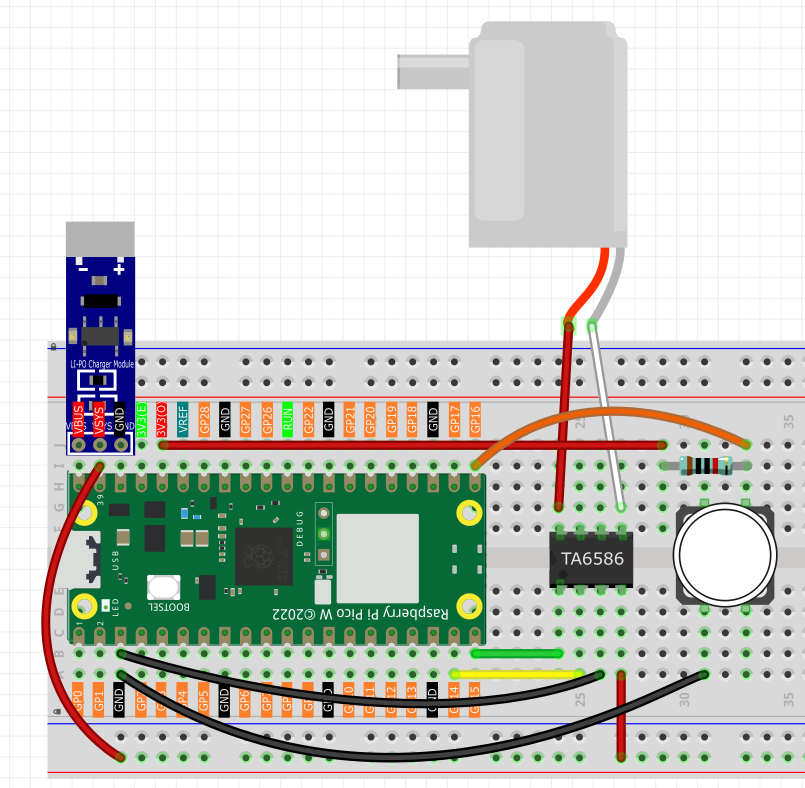
Since DC pump require a high current, we use a Li-po Charger module to power the motor here for safety reasons.
Make sure your Li-po Charger Module is connected as shown in the diagram. Otherwise, a short circuit will likely damage your battery and circuitry.
Connect
Code
Note
Open the
2.6_pump_control.pyfile under the path ofUltimate-Starter-Kit-for-Pico-W\Python\1.Projector copy this code into Thonny, then click “Run Current Script” or simply press F5 to run it.Don’t forget to click on the “MicroPython (Raspberry Pi Pico)” interpreter in the bottom right corner.
After running the code, connect a button to pin 16 and press it to toggle the pump on/off! When ON, you’ll hear the pump motor spinning and see water flowing through the tube. The serial monitor shows “Power on” and “Power off” messages. Perfect for creating remote-controlled irrigation systems!
The following is the program code:
import machine
import utime

# Initialize motor control pins
motor1A = machine.Pin(14, machine.Pin.OUT)
motor2A = machine.Pin(15, machine.Pin.OUT)
# Add a control switch
switch = machine.Pin(16, machine.Pin.IN, machine.Pin.PULL_UP)

# Add a state variable to record the pump state
pump_state = False
# Add a variable to record the last switch state
last_switch_state = 1  # 1 indicates not pressed

def pump_on():
    motor1A.high()
    motor2A.low()

def pump_off():
    motor1A.low()
    motor2A.low()

# Initial state: Off
pump_off()

while True:
    current_switch_state = switch.value()

    # Detect the moment when the button changes from not pressed to pressed (falling edge)
    if current_switch_state == 0 and last_switch_state == 1:
        utime.sleep_ms(20)  # Debounce
        if switch.value() == 0:  # Confirm the button state again
            pump_state = not pump_state  # Toggle the state
            if pump_state:
                pump_on()
                print("power on")
            else:
                pump_off()
                print("power off")

    last_switch_state = current_switch_state
    utime.sleep_ms(50)  # Add a delay to avoid excessive CPU usage