1.8 Gentle Press
A micro switch is a precision button designed for detecting gentle touches! Unlike regular buttons, it has three pins: C (Common), NO (Normally Open), and NC (Normally Closed).
Think of it like a see-saw: when not pressed, C connects to NC. When pressed, C flips to connect to NO instead. This makes it perfect for applications requiring precise, reliable switching.
Component List
Raspberry Pi Pico W x1
MicroUSB cable x1
830 Tie-Points Breadboard x1
Jumper Wire Several
Resistor 10KΩx1
Capacitor 104 x1
Micro Switch x1
Component knowledge
Micro Switch
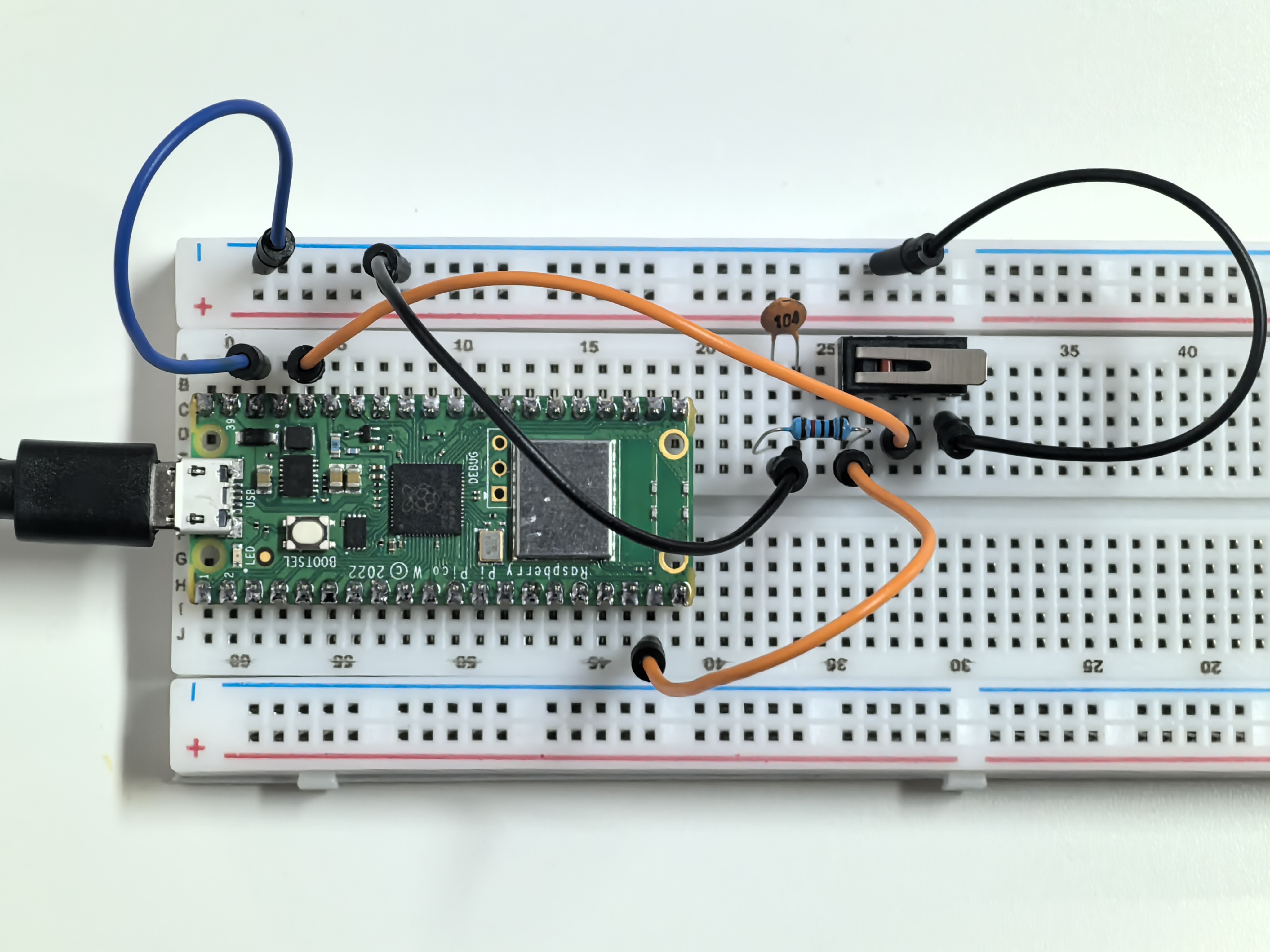
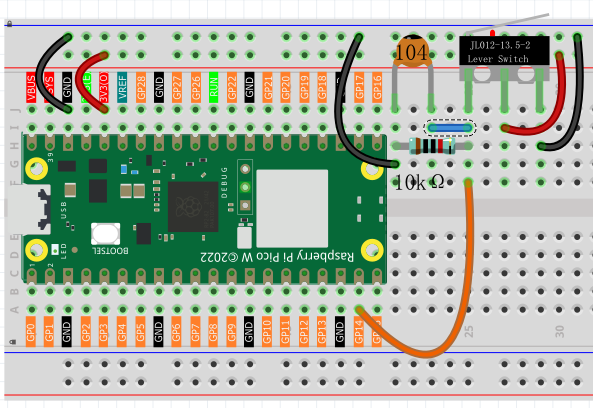
How our circuit works: - Not pressed: C connects to NC → GP14 reads LOW (0V) - Pressed: C connects to NO → GP14 reads HIGH (3.3V)
The 10KΩ pull-down resistor ensures GP14 stays LOW when unpressed, and the 104 capacitor eliminates button bounce (rapid on/off signals when pressing).
Connect
Code
Note
Open the
1.8_gentle_press.pyfile under the path ofUltimate-Starter-Kit-for-Pico-W\Python\1.Projector copy this code into Thonny, then click “Run Current Script” or simply press F5 to run it.Don’t forget to click on the “MicroPython (Raspberry Pi Pico)” interpreter in the bottom right corner.
After running the code, try pressing the micro switch for different durations. The program will measure how long you press and give different responses: “QUICK TAP” for short presses, “MEDIUM PRESS” for moderate holds, and “LONG HOLD” for extended presses, complete with sound effects!
The following is the program code:
"""
Press Duration Counter

Measures how long a button is pressed and provides
different responses based on press duration.
Shows statistics about button usage.
"""

import machine
import utime

# Pin definition for the button
BUTTON_PIN = 14                     # button connected to pin 14

# Timing constants for press categorization
QUICK_PRESS_THRESHOLD = 500         # milliseconds for quick tap
MEDIUM_PRESS_THRESHOLD = 2000       # milliseconds for medium press
SCAN_DELAY = 10                     # delay between scans in milliseconds

# Variables to track button state
is_pressed = False                  # current button state (True = pressed)
was_pressed = False                 # previous button state for comparison
press_start_time = 0                # when the button was first pressed
press_duration = 0                  # how long the button was held
total_presses = 0                   # count of total button presses

# Initialize button
button = machine.Pin(BUTTON_PIN, machine.Pin.IN)

def show_instructions():
    """Display instructions at startup"""
    print("*** Press Duration Counter ***")
    print("Press and hold the button for different durations:")
    print("- Quick press (< 500ms): Short beep")
    print("- Medium press (500-2000ms): Medium beep")
    print("- Long press (> 2000ms): Long beep")
    print("===============================")

def categorize_press_type():
    """Categorize press type based on duration"""
    global press_duration

    print("Press type: ", end="")

    # Check duration and provide appropriate feedback
    if press_duration < QUICK_PRESS_THRESHOLD:
        print("QUICK TAP")
        print("♪ Beep!")           # short sound effect
    elif press_duration < MEDIUM_PRESS_THRESHOLD:
        print("MEDIUM PRESS")
        print("♪♪ Beep-Beep!")     # medium sound effect
    else:
        print("LONG HOLD")
        print("♪♪♪ Beep-Beep-Beep!") # long sound effect

def show_statistics():
    """Display usage statistics"""
    global total_presses

    print(f"Total presses: {total_presses}")
    print("---")  # separator line for readability

def handle_button_press():
    """Monitor button state and detect press/release events"""
    global is_pressed, was_pressed, press_start_time, press_duration, total_presses

    # Read current button state
    is_pressed = bool(button.value())

    # Check if button was just pressed (transition from not pressed to pressed)
    if is_pressed and not was_pressed:
        # Record the time when button was pressed
        press_start_time = utime.ticks_ms()
        print("Button pressed... ", end="")

    # Check if button was just released (transition from pressed to not pressed)
    if not is_pressed and was_pressed:
        # Calculate how long the button was held
        current_time = utime.ticks_ms()
        press_duration = utime.ticks_diff(current_time, press_start_time)
        total_presses += 1  # increment total press counter

        # Show the duration
        print(f"Released! Duration: {press_duration}ms")

        # Analyze the press type based on duration
        categorize_press_type()

        # Show current statistics
        show_statistics()

    # Remember current state for next loop comparison
    was_pressed = is_pressed

def main():
    """Main function"""
    show_instructions()

    try:
        while True:
            # Check button state and handle press events
            handle_button_press()

            # Small delay for stability
            utime.sleep_ms(SCAN_DELAY)

    except KeyboardInterrupt:
        print("\nPress counter stopped.")
        print(f"Final statistics: {total_presses} total presses")

if __name__ == "__main__":
    main()
Phenomenon