2.2 Musical Melody Player
Now let’s turn our Pico into a music player! We’ll switch from an active buzzer to a passive buzzer - the difference is like switching from a car horn to a piano.
Active vs Passive Buzzer: - Active buzzer: Fixed tone, just beeps (like a smoke alarm) - Passive buzzer: Variable frequency, can play musical notes (like a speaker)
With a passive buzzer, we can control the frequency to create Do-Re-Mi-Fa-Sol-La-Ti notes and play actual melodies! Time to make some music! ♫
Component List
Raspberry Pi Pico W x1
830 Tie-Points Breadboard x1
Transistor S8050 x1
Resistor 1KΩ x1
Passive Buzzer x1
Jumper Wire Several
Component knowledge
transistor
Buzzer
How musical tone generation works:
Frequency Control: - Different frequencies = different musical notes (262Hz = C4, 440Hz = A4, etc.) - Arduino’s tone() function generates precise frequencies - noteDurations[] controls how long each note plays
Power Amplification: The transistor boosts the signal for clearer, louder music - like adding an amplifier to a guitar!
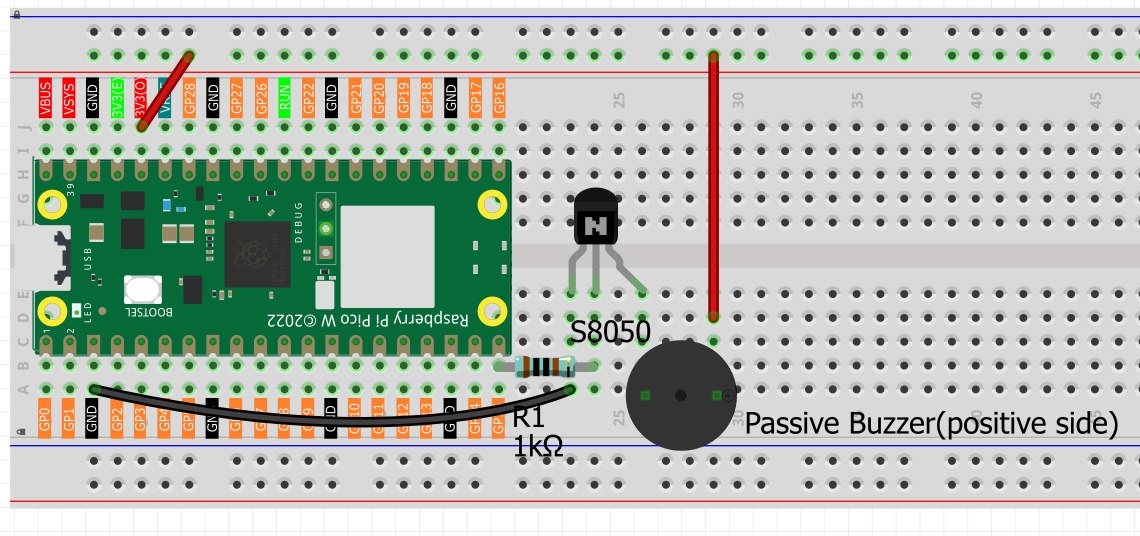
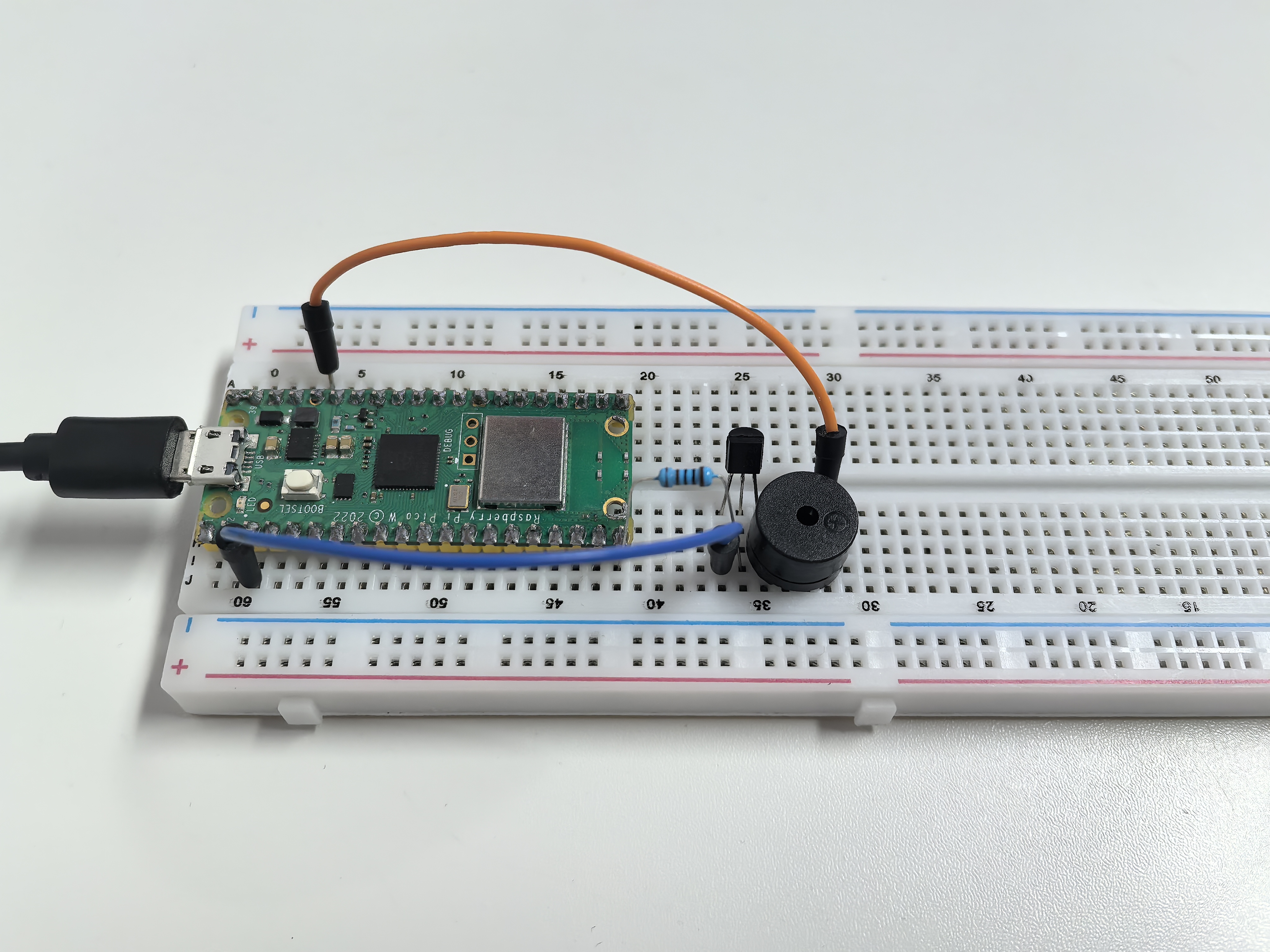
Connect
Two buzzers are included in the kit, we use a passive buzzer (one with an exposed PCB on the back).
The buzzer needs a transistor to work, here we use S8050.
Code
Note
Open the
2.2_musical_melody_player.inofile under the path ofUltimate-Starter-Kit-for-Pico-W\Arduino\1.Projector copy this code into Thonny, then click “Run Current Script” or simply press F5 to run it.Or copy this code into Arduino IDE.
Don’t forget to select the board(Raspberry Pi Pico) and the correct port before clicking the Upload button.
After running the code, enjoy the classic “Twinkle Twinkle Little Star” melody! ✨ The serial monitor shows each note being played with its frequency (Hz). The melody repeats every few seconds, and you can see the musical progression: Do-Do-Sol-Sol-La-La-Sol… It’s like having a tiny digital music box!
The following is the program code:
/*
  Musical Melody Player

  Plays "Twinkle Twinkle Little Star" melody using
  tone generation on a buzzer or speaker.
*/

// Musical note frequencies (in Hz)
const int NOTE_C4 = 262;    // Do
const int NOTE_D4 = 294;    // Re
const int NOTE_E4 = 330;    // Mi
const int NOTE_F4 = 349;    // Fa
const int NOTE_G4 = 392;    // Sol
const int NOTE_A4 = 440;    // La
const int NOTE_B4 = 494;    // Ti
const int NOTE_C5 = 523;    // Do (high)

// Pin and timing constants
const int BUZZER_PIN = 15;          // buzzer connected to pin 15
const int MELODY_LENGTH = 14;       // number of notes in melody
const int REPEAT_DELAY = 2000;      // delay before repeating melody

// "Twinkle Twinkle Little Star" melody
int melody[MELODY_LENGTH] = {
  NOTE_C4, NOTE_C4, NOTE_G4, NOTE_G4,  // Twin-kle twin-kle
  NOTE_A4, NOTE_A4, NOTE_G4,           // lit-tle star
  NOTE_F4, NOTE_F4, NOTE_E4, NOTE_E4,  // How I won-der
  NOTE_D4, NOTE_D4, NOTE_C4            // what you are
};

// Note durations (4 = quarter note, 8 = eighth note, 2 = half note)
int noteDurations[MELODY_LENGTH] = {
  4, 4, 4, 4,  // quarter notes
  4, 4, 2,     // quarter, quarter, half
  4, 4, 4, 4,  // quarter notes
  4, 4, 2      // quarter, quarter, half
};

void setup() {
  // Initialize serial communication
  Serial.begin(115200);
  Serial.println("=== Musical Melody Player ===");
  Serial.println("Playing: Twinkle Twinkle Little Star");
  Serial.println();

  // Play the melody once on startup
  playMelody();
}

void loop() {
  // Wait and then repeat the melody
  Serial.println("Playing melody again...");
  delay(REPEAT_DELAY);
  playMelody();
}

// Function to play the complete melody
void playMelody() {
  Serial.println("♪ Now playing: Twinkle Twinkle Little Star ♪");

  // Play each note in the melody
  for (int noteIndex = 0; noteIndex < MELODY_LENGTH; noteIndex++) {
    // Calculate note duration
    int noteDuration = 1000 / noteDurations[noteIndex];

    // Play the note
    tone(BUZZER_PIN, melody[noteIndex], noteDuration);

    // Show current note being played
    Serial.print("Note ");
    Serial.print(noteIndex + 1);
    Serial.print("/");
    Serial.print(MELODY_LENGTH);
    Serial.print(": ");
    Serial.print(melody[noteIndex]);
    Serial.println("Hz");

    // Pause between notes (note duration + 30% for clear separation)
    int pauseBetweenNotes = noteDuration * 1.30;
    delay(pauseBetweenNotes);

    // Stop the tone
    noTone(BUZZER_PIN);
  }

  Serial.println("Melody complete!");
  Serial.println();
}
Phenomenon